
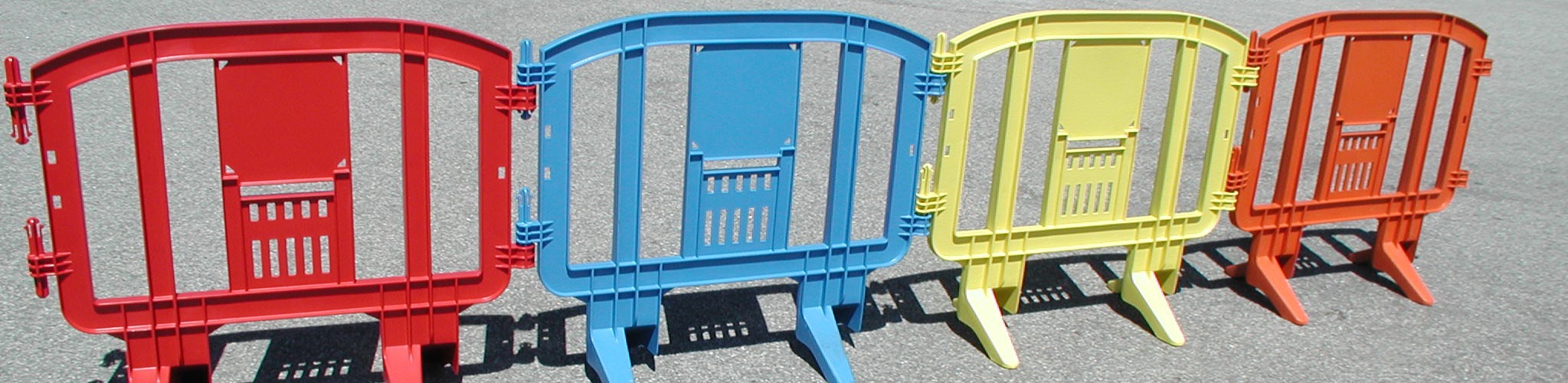
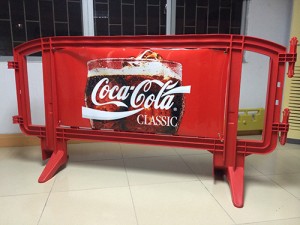
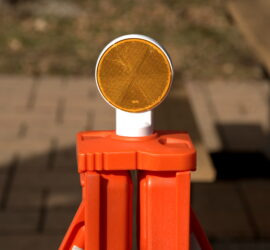
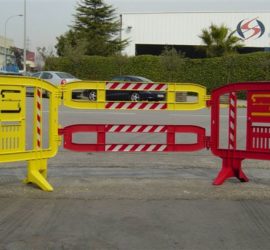
Guardian Plastic Mini Barricades


Movit™ Barricades
GUARDIAN
Plastic Safety Products

A Division of
The Tamis® Corp.


Sales Office:
10700 Frankstown Rd.
Suite 105
Pittsburgh, PA 15235

888-436-1232


Tamis Corp Divisions
BBB Online

Movit™ Barricade Testing

Tests Conducted
Realized by LGAI (Laboratorio General
de Ensayos e Investigaciones)
File number 99011028

LAboratory General Testing
Drop Test
polyethylene barricades
The free-fall vertical impact test was carried out using barrier section under ambient conditions (23�C/73�F 50% R.H.) and after having been conditioned for 4 hours in a "CLIMATEST" climate-controlled chamber at a temperature of -10�C/14�F. The drop was performed with the barrier section in a tilted position, i.e., impact first occurred on one of the two legs of the railing, as seen in the photo.

The drop was repeated with the other leg, and finally against each one of the two feet of each individual leg. A total of five drops for railing at ambient conditions and five drops for the railing conditioned at -10�C/14�F were made. The drop height was one meter at all times.

Drop test results: SATISFACTORY:
No breaks, cracks or deformation were observed in the railing or its legs.
Compression Test Point
durable plastic barricades
4.1.2 of ANSI A10.18 states that "the structure of the railing must withstand a load of at least 90.7kg/200 pounds applied in any direction at any point of the top". The test was conducted with an "IBERTEST" press, EMIB60 model. A load of 500kp (much higher than the minimum required by the above standard) was applied vertically. The test duration was 4 hours.

Compression test results:
SATISFACTORY:
No breaks, cracks or deformation were observed in the railing.

Bending Test
barricades with strong reinforced frame

At the middle of the top part of the railing, a compressive force of 61kp was applied at the side for one hour and the deformation experienced at this point was measured at the same time. When the force was released at the end of the test, the deformation was 9mm/0.354inch, with a residual deformation of 4mm/0.157inch after one hour.

Water Absorption

The test was conducted as per UNE 53-028-90. Water absorption by a plastic material may lead to swelling and cause alterations in the dimensions and/or physical properties of the material. Several samples of the railing were cut, then weighed before and after being immersed in distilled water at 23�C/73�F for 24 hours. Several other samples were placed in boiling water for 30 minutes. The weight difference represents the increased mass due to absorption.
Water absorption results: SATISFACTORY: Samples at 23�C/73�F for 24 hours: 0.009% Samples at 100�C/212�F for 30 minutes: 0.022%

Determination of Latent Stress and Strain

The test was conducted as per UNE 53-248 and consisted of immersing the samples in a hot surfactant bath for a certain amount of time, then removing the samples from the surfactant bath and inspecting them to see if any cracks, swelling or breaks have appeared at any point or area of the sample. The time period was 24 hours and the temperature was 80�C/176�F.
Test results: SATISFACTORY: No cracks, swelling, grooves or breaks were observed in the samples.

Ageing Tests

An entire railing was immersed in a "CLIMATEST" climate-controlled chamber in order to conduct ageing tests consisting of the following climate-controlled cycles: 4 hours at -10�C/14�F, followed by 8 hours at 60�C/140�F and 90% relative humidity. A total of 4 cycles were carried out, for a total of 48 hours. After the railing was removed from the chamber and inspected damage due to deformation or cracks, the drop test was repeated from a height of 1 meter against one of the legs.
Results: SATISFACTORY


Copyright 2006 • The Tamis Corporation
Graphics and text may not be reproduced without the written consent of The Tamis Corporation.